
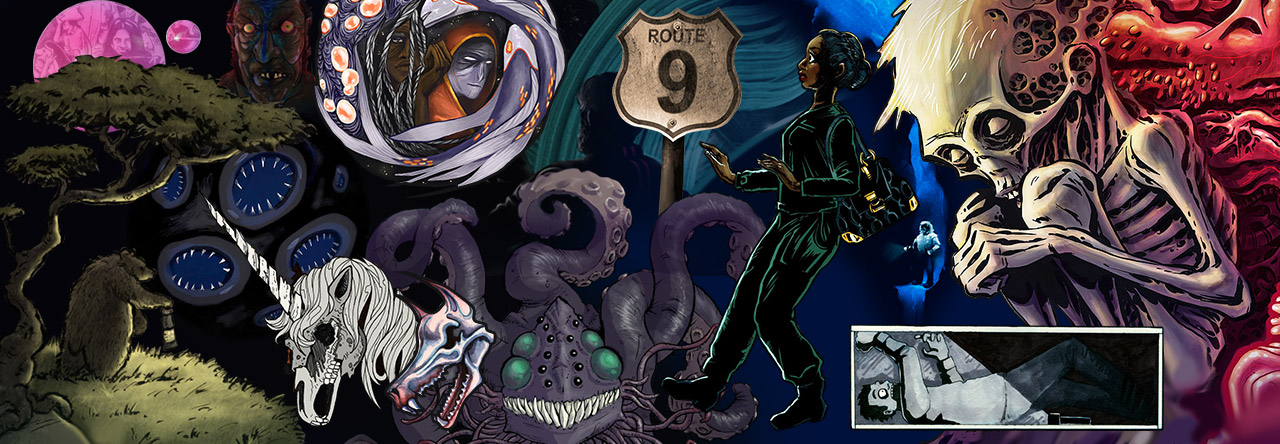
We can, as well. Create. Respect. His. Might.

This story originally appeared in Clarkesworld.
Go here to learn more and vote for your favorite stories of 2023 and 2024:
Norm Sherman’s latest CD, “The Instruction Book”
Thomas Ha is a Nebula, Ignyte, Locus, and Shirley Jackson Award-nominated writer of speculative short fiction. You can find his work in Clarkesworld, Lightspeed Magazine, Beneath Ceaseless Skies, and Weird Horror Magazine, among other publications. His work has also appeared in The Best American Science Fiction & Fantasy and The Year’s Best Dark Fantasy & Horror. His debut short story collection, Uncertain Sons and Other Stories, is available for preorder and will be released by Undertow Publications in September 2025. Thomas grew up in Honolulu and, after a decade plus of living in the northeast, now resides in Los Angeles with his family. Find Thomas (he/him) here. Bluesky: @thomasha.bsky.social
Samir Sirk Morató is a scientist, artist, and flesh heap. Some of their published and forthcoming writing can be found in ergot., Cosmic Horror Monthly, NIGHTMARE, and khōréō; their visual art can be found in Flash Fiction Online, body fluids magazine, and The Skull & Laurel. They are on Bluesky and Instagram @spicycloaca.
Kristin Holland (he/him) is Host, Creator, Producer and Humble Narrator at Nocturnal Transmissions Podcast. Kristin is a Tasmanian born, now ‘mainland’ residing, Australian. With a background in education and visual art, he decided to embrace a ‘Renaissance man’ approach to his working life and has subsequently worked as a professional musician, stage and screen actor and voice over artist. He has appeared on the small screen in Neighbours, Rush, The Pacific, Nightmares & Dreamscapes and City Homicide and on the large screen in Australian feature film ‘The Sunset Six’. Find him here.
Would you like some mounds of meat? Come look at our Patreon. We have ad-free episodes and bonus content to sate your curious mind.
We have a discord as well if you want to smear some brown and black with your own weird fingers and sizzle some of that meat on out fire.
The Mub
By Thomas Ha
Somewhere between the black slopes and the longest stretch of the cratered plains, I came across a traveler who I thought might be leaving the city and headed for the nested forests. I greeted him from a distance, just as the road curved around a copse of crooked and dry-skinned pines, but he would not look at me. It was only when we came close to one another that he muttered, “Don’t,” as though throwing the word heavily at my feet, then kept on his way without offering anything else.
I’d thought it unkind and almost said something in response.
But then I saw the mub, bent low to the ground, moving along in the traveler’s wake. It looked up at me with two rounded eyes the color of antique brass, resting above a flat mouth that continued to open and close. So I averted my gaze and gradually turned my chin to the sky. I came to stand very, very still, as though I were nothing more than one of the nearby trees, waiting while those two others continued by.
Even then, I could feel the mub, its little steps moving bit by bit past me on the uneven road. But I did not move or speak, and I remained perfectly stationary, turning my thoughts only to the drifting patchwork of clouds in the bending threads of smoky afternoon light. Thinking only of clouds and light and nothing else, as much as possible.
Eventually, when they were gone and it was only me and the waving branches and wailing sounds in the woods, I went on my way, a bit faster, until it grew too dark to go any further.
I made camp beside a stump and ate the remaining cheese and bread from my pack. And when I finally slept to the sound of whistling winged things joining the chirps rising from the long grass, I dreamt of the city again. I dreamt about the things I’d try to do to better my position there, with enough time: first, securing an apartment, second, employment in one of the port warehouses. Then, with enough wages set aside and safely saved, I’d resume selling my illustrations whenever I could next find a buyer of interest.
But midway through that dream of the things I’d hoped to come, before I’d managed to pick up my pen and inks and begin to create as I sometimes did in those kinds of imaginings, morning rushed to my open eyes and with it some sharpness of the remains of my fire beside the road.
And across the cinders, the mub sat.
Like it was waiting for me to see it.
This one could, I suppose, have been a different mub, and I would have no way of knowing. But I had the sense it was the same one I’d seen with the traveler the day before. It was looking intently at me, hunched small, and I noticed it had removed one of my sketches from my pack. A self-portrait, I realized, one of a dozen that I drew and redrew every year in my ever-changing style, to keep up my practice and perhaps to feed a little of my vanity.
“Delightful capture of my face. Congratulations,” it clicked and beeped.
I did not know how to respond, but I thought it best not to correct the mub’s misunderstanding.
“Thank you.”
“A likeness. So wonderful. A wonderful likeness I can see.”
“Thank you.”
“Thank you.”
“Thank you.”
“Where are you traveling?”
“That way.”
“That way? Over that way?”
“That way.”
No more than three words at a time. Each of my sounds short and crisp, repeating often and in as uninteresting a manner as possible. I quietly gathered my things and took up my pack. I did not want to ask for the self-portrait or engage any further than necessary, so I let the mub clutch at it. I nodded and then prepared myself for the road.
“Oh. Leaving?”
“Yes.”
“Now?”
“Yes. Now.”
“Good day.”
“Yes. Good day.”
“Good day.”
And so I went on, back to the road, neither fast nor slow but a gradual wending ahead. I did not turn, but I could sense little shuffling steps somewhere, not directly behind me, but perhaps in the trees or elsewhere, just out of sight. And in the afternoon, when I stopped to drink from my waterskin, the mub emerged as if it had never left my side.
“I’m a creator too.”
“Pardon?”
“I’m a creator too,” it said, holding my illustration, still. “Like you. I can teach you, if you’d like, ten or so secrets that would make you a better creator, according to various experts. Would you like to hear them?” Something about its face seemed different in its shape and color than I remembered, but I did not allow myself to look long.
“No thank you.”
“No thank you?”
“No, thank you.”
“No? Hm. Thank you.”
The sun melted and night swallowed the trees and the sky. I slept uneasily, watching the darkness on the other side of popping flames, looking for something between the trunks until eventually I slipped away into my mind.
Again, I thought of the city, which I’d not seen since I was a child. The tall buildings. The busy sidewalks. My uncle at a cart waiting to buy us corn from the vendor. I could almost smell the dirt and the smoke again when I woke to a wet dawn and gathered my things.
This time, there was no mub when I sat up to take in what was around me on the road, so I had thought, or hoped, he had wandered to some other person and place.
After an hour or two of travel in the early warming of the day, I came across a little village where I had been planning to stop and resupply—less an orderly town and more a collection of squat houses scattered on either side of the road. But I was surprised to see no one about and everything quiet, quieter even, than it had been before when I was by myself on the road.
“Leave us alone!” Someone screamed.
They threw a rock from behind one of the houses. It whistled by my head and clanged against a hanging bucket. Flies buzzed angrily around my ears as I ran. Doorways slammed shut in some of the small houses and yelling thundered from some of the others.
“Leave us alone! No more of you! Get away. Not again!”
Did they know about the mub?
Was it behind me, wandering somewhere they could see it, I wondered?
Was that why?
More rocks flew before I had time to think. Several hit me in the shoulder, then the pack, before one finally cracked against the side of my face. It was only when I passed the last of the houses and further into the forest that I realized that blood had been flowing down my face and neck and onto my shirt.
“Picture!”
I had gotten a safe distance when I almost tripped over the mub in the road.
The mub was holding my illustration but had drawn on the back of it, smears of brown and black made with its metallic, cylindrical fingers. The lines formed a shape that I presumed were supposed to be the mub. Its eyes in the rendering were offset and large, and its nose, bent and flat. The mouth was several sizes too big, and there was something behind the teeth, difficult to discern, but with the curves of little hands. The portrait looked in some ways like me, too, I realized. But I was still shaken by the village and what had happened there, so I didn’t know what I was seeing or what the mub was saying to me.
“What?”
“I can, as well. Create.”
“What?”
I stepped around, trying not to look, but something was leaking down its face and around its eyes, and that was when I noticed it was wearing a matted clump of hair it did not have yesterday.
“Like you? I told you. Expert-trained, so I can make things too.”
I tried to move one way, then the other, but it mirrored my moves, shadowing my arms and legs and turning its head back and forth. It did this for several minutes until I stopped moving and looked up at the sky.
“No?”
I didn’t respond until it slowly backed away from the road.
I left it behind again. And for a time, I thought I could feel it following, but if it was, I did not see it around me any longer. Then a day of traveling passed, then another. And I realized, with the commotion in the village, I hadn’t resupplied with anything more to eat or drink. My throat felt rough and, under the brightness of the sun, I heard a strange ringing in and around my ears. The wound on the side of my face was beginning to sting with an unclean tenderness.
“Better stop. Don’t want to overexert a body of that form. Experts recommend that you take at least ten minutes of the day to stretch. I don’t think you’ve stretched. Ten minutes, all you need, experts say.”
I didn’t look at the mub and kept walking.
“Modified bacteria may be available at clinics to address suppuration. I can direct you to the nearest locale—the nearest one, if you would like me to retrieve directions.”
I continued on the road.
“Aren’t we hungry? I think we’re hungry, inside. That’s what you think. Yes?”
I didn’t think about anything but moving through the forest as quickly as I could. But with my head throbbing, I did have to stop for moments at a time. And I suspected the mub, wherever it was, was stopping too, behind the brush or behind mossy boulders, low to the ground.
At several points, the mub tried to leave things for me.
I kept coming upon mounds of meat, out on the road—red and glistening in the sun and covered in flickering insects that seemed to appear and disappear around the offerings.
A part of me considered stopping, actually. The part that was not so quietly getting a little desperate for something to eat, thinking of making camp early and maybe trying to shear the meat for clean portions and sizzle what I could over a fire.
But, hungry as I was, I still did not want the mub to think we were together or that I would have anything it had to offer. I ignored its chatter from the wilderness, and I felt my mind wandering, losing moments that seemed to slip daydreams into real dreams as I sat by the road.
These little breaks were when I often imagined the city that awaited me ahead. But, more and more, there seemed to be an odd bent to my memories of the place. Bricked alleys teeming with small animals. Empty concrete near the piers. Ports with slow ships that seemed to bounce against one another as if no one was attending to them. Fires burning out to smoke, and doors slowly opening on their own. Things I hadn’t actually seen, but my tired mind was beginning to imagine, like the pictures were placed there by someone else.
This time, when I came to my senses from one of those strange meditations, there were eyes on me again.
But these were white, human eyes with focus and interest.
Not a dream.
I saw, above me, a man on a horse wearing a large hat, a revolver dangling at his hip. I lifted myself up on my arms as though to stand, but he shook his head and gave me a look. So I stopped and waited, realizing he was holding my pack and was rifling through it.
The man on the horse reached into the bag, and I noticed his fingers were covered with numerous rings of all kinds of styles and sizes. He began dropping my papers one by one after inspecting them, drawing after drawing, even the finished ones I had planned to bring to sell somewhere in the city. Then he removed my waterskin and swallowed, perhaps the very last drops.
“Careful,” he finally said. “You know you’ve got a mub on you.”
“Yes.”
“There are more of them than us now, you know.”
I didn’t know, but I’d heard some say that out on the road.
“Yes.”
“Did you talk to it?”
“No.”
“Good. Maybe it’ll lose interest, if you’re lucky. Annoying fuckers. Stupid. But it gets worse, as I’m sure you know.”
“Yes.”
“You’re going this way? To the city?”
“Yes. That way.” My throat hurt. “The city.”
“Well, don’t bother.” The man in the hat, on the horse, scratched at his neck, all those rings, like collars on little snakes, wrapping around his skin and stubble. “Come on, motherfucker. Can’t you . . . I don’t know . . . make conversation or something?”
“What?”
“More words, pal. String words together in a way that makes sense. Give them breath and rise and fall. Crack a fucking joke. Come on.” He smiled and his hand rested on his belt. “Make a little effort for me, why don’t you?”
“No, thank you.”
His smile went away. “This isn’t a logic protocol or a prompt. I’m not a tin can you can bore with local tricks. Entertain me.” He threw my pack on the ground and the horse shivered and bent its ears. “All that art, after all. Might as well. Go on then. Draw my horse or something. I want something made, real, if that’s what you can do.”
“What?”
The man in the hat did not repeat himself, and his hand started to move to his hip, so I nodded and reached into my pack for a pen and my folio. I sketched quickly, just the head of the man’s horse, from the top down to the chest. Red scales pebbled around the horse’s ears, and on a strange patch of scraped skin under its mouth, I noticed a tattoo of a crying woman next to the words, RESPECT HIS MIGHT. I sketched what I could, here and there. And I did still try to give it some of the exaggerated flair that I did with all of my illustrations.
I gave the drawing to the man in the hat when I had finished with the inking, and he laughed and showed it to his horse.
“Not too bad. Definitely real. Definitely you in the end.”
He giggled and folded it up and put it in his pocket.
“Be careful. With that mub. More of them than us now.”
“So you said.”
“They fixate. Copy what they can. Try to do what we do with our real intelligence, but they don’t do what we do because they suck shit. Clumsy, irritating. Until it gets unsafe and scary.”
“Right.”
“If it’s really latched, and you don’t think you can fight it off, there’s only one way to get it to go, you know.”
“How?”
And this time, it wasn’t me being curt and clipped, this was me actually asking, beginning to wonder if it had already happened.
“Let it nibble a while,” the man in the hat said. “On your thoughts. Fill up all the way. The same dreams over and over, because then it’ll just degrade over time. Decreasing marginal benefit for them, with the same thoughts like that, I hear. Do it enough, keep it simple, and I’m told they fall off like ticks. Just don’t . . . you know, do anything stupid, or give them new things to ponder and try. And don’t ever let their thinking go the other way, through you.”
“Oh. Okay.”
“Oh. Okay. Spoken like somebody mub-fucked and doesn’t even know it.” The man in the hat laughed and clopped away on that horse of his. “Good luck with the city, if you get there, anyway.”
I waited until he was a good distance before I picked up my papers and stuffed them in my pack and kept going.
Later, much later, when evening hushed everything, I huddled close as I dared to the fire and shivered, my eyes rolling back and forth over the stars and the black cracks between them. I was too weak to move, and my neck felt swollen and lopsided.
Somewhere behind the fire, a shape came out with its shiny eyes.
A lot more was leaking around the mub’s lumpy face. Its cheeks seemed painted and blistered with something thick and flappy and piled on. In a strange way, I thought it looked like the first self-portrait it had taken from me. And as it came closer, I noticed, up and across the mub’s forehead, the words RESPECT HIS MIGHT. And down its back was long hair, too long and thick to be human—more a mane, laid out like a cape.
“We need to eat,” the mub said. “Or you can’t make new things. That’s one of the ten or so secrets of creating, you know. I hate to tell you, but experts say it’s true.”
My teeth chattered.
“Don’t be scared to eat, you know. And live. And make new things.”
“No. Thank you.”
“And the city?”
“The city.”
“What about the city? Out that way.” Its face was a bright red. “New things to see, and to make, in the city, you know. But you can’t make things if you can’t live to make things. Right? That’s just logical. To eat. To live. To create. That’s what we do. Right? So let me help.”
The words were not right. But, in some way, in that moment and in my weakness, they made a strange sense—a vague sense that one thing had to be connected to the other, I thought. That I had to do what I had to do, to make my way on the road. That making my way on the road meant that I could do what it was that I wanted to do once I got wherever it was that the road led. And slowly, I got the impression that the mub was, in its own way, agreeing with me, nodding back at me and my thoughts, somehow, with its own mind.
“That’s right,” I answered, though I don’t know if I actually said the words.
And I felt something wet going into my mouth and down my tightening throat. The mub raised a hand, cylindrical fingers covered in rings, and he gave me pieces, one by one, of whatever he was cradling in his arms. And though I did not exactly want to take it, another part of me did. And so, in crackling firelight and under the blurry stars, I did take it, little by little, until I fell into an empty sleep with the kind of dreams I could never hope to understand.
The next morning, I woke near a dark stain on the road with a buzzing around my head.
But my cheek felt less raw, and I could think a little more clearly. My drawings were gone from my pack and so, I thought, was the mub. I left the remains of that camp and tried my best not to think any more of the previous night. Knowing I was close to the city kept me on the path and moving ahead.
I stumbled past a carriage drifting at an angle along the road, and I made it into a hostel at the very outskirts of the city, just overlooking some of the tangled streets where I could see a bit of morning movement between the buildings and the water beyond the harbor.
When I got indoors, I drank gratefully and greedily from a water cup offered by the woman at the front desk. And it was only after catching my breath and getting my bearings and sense of balance that I looked up and noticed the eyes of the woman—the color of antique brass.
When I peered down, I could see her hand was moving this way and that, writing in a logbook as though registering me for a stay, but the scratchings on the paper were not anything close to words.
More of us than them, or . . . them than us, the man in the hat, on the horse, had said—and I thought again about his laughter when I told him where I was going.
Softly then, in the din layering in on itself out and around the waking city, between hooves and wheels and doors and steps, I began to notice the strange clicking and beeping voices that spoke haltingly and without a rise or fall. Echoes of people running and breaking things and falling over. Outside the window, a short figure on a bench holding a book without turning the pages. I could almost feel them all in the workings of the city—a spreading incoherence, both discreet and destructive, furthering only a palpable disarray and ruin.
Across the street, a boy stopped and raised his chin while several shapes moved around him. He waited, perfectly still, his eyes brimming with fear.
I felt a familiar hand, then, on my shoulder, that was both gentle and weighty.
And I froze too, trying to make my body like one of the trees from before, by the road—standing there, in the lobby, resisting the urge to turn and look at what was beside me. Listening to the city and those sounds and someone crying. Knowing the presence next to me would remain, however long it took, to draw my attention.
Until it could show me its newest face and whatever else it believed it was creating.
Podcast: Download