
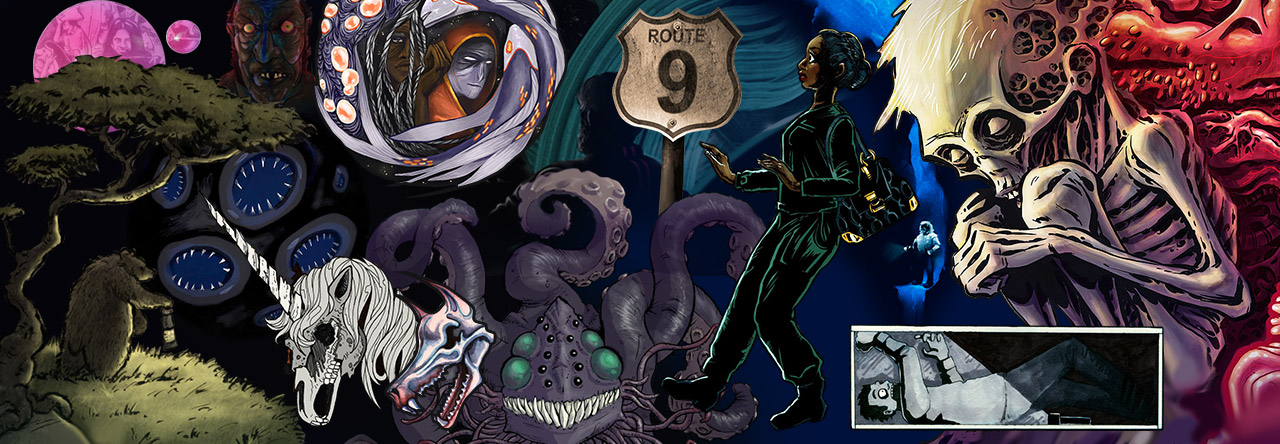
 Come walk the road (or unsettling staircase leading down into the earth) less traveled this week on the Drabblecast, as we present author Rory Say’s story “The Bridge.” Enjoy!
Episode Art by Bo Kaier
The Bridge
by Rory Say
Before they were let loose on the beach, the boy and his cousin had been warned of the tide. When it went out, a great bar of sand breached the waves, connecting the shoreline to a little island out in the water. You could cross this bar of sand, the boy and his cousin were told, and explore the little island out in the water, so long as you hurried back before the tide turned and swept the bridge away. They had been warned of this by the boy’s aunt, first in the car, then in the rented caravan, and a final time when they arrived at the beach and saw the island out in the sea.
At first there was no bar of sand, only dull, unsettled ocean beneath a warm, milky sky. They had the beach to themselves save for the odd seabird standing watch on a log, or teetering drunkenly in the soft breeze. This did not deter the boy and his cousin, neither of whom were used to seeing such bodies of water. Quickly they shed their clothes and tore off their shoes, kicking sand behind them as they dashed madly to the shore. Meanwhile, the boy’s aunt placed a lunch basket down in front of a wide hunk of driftwood, and spread three striped towels one beside the other.
The afternoon deepened. Over and over, the boy and his cousin ran shrieking in and out of the freezing sea. They collected shells and dead sand dollars. The sun came out, cast the world in clear, golden light, and was covered again. The boy buried his cousin to the neck in wet sand at the water’s edge, then laid down on his back to be buried himself. When they both grew tired, they returned to the towels and were given sandwiches and sliced fruit by the boy’s aunt, as well as red juice from a glass bottle. And it was there, while eating and resting on the towels, that they began to see the bridge of sand emerge in front of them.
It was the boy’s aunt who pointed it out. She had been reading a book, but now she placed it in the empty lunch basket and told the two boys to look up at the water. They did. It was faint at first but definitely there, a dark, dividing line that stretched out to the grey, stony island. The boy and his cousin watched with dazed attention, each noting that, gradually, as the sea sucked itself further out with each retreating wave, the line grew wider and more defined, until at last its whole length could be seen above the surface.
Together they rose with the same giddy laugh and ran back down the beach. There was more of it to cover now, the newly revealed damp sand oddly warm underfoot. When they reached the bridge, they slowed. Already it was wide enough that they could walk side by side, and still it was growing wider. Waves lapped quietly to left and right.
There were things to look at while they crossed, things the sea had left behind—great clumps of tangled black kelp; tiny crabs finding their sideways way back to the water; a dead jellyfish flattened to the sand, milkily transparent and shapelessly strange. This the boys poked, then impaled, with sticks they’d carried with them before moving wordlessly on.
Half-articulated in each of their heads was the thought that the path on which they trod had appeared solely for themselves, for still nobody else had joined them on the beach. It seemed in some way unthinkable that anybody would.
The little island, when they reached it, had its own little beach, rockier than the one behind them. A rich marine funk hung in the air. The first thing the boy and his cousin did was etch their names with their sticks in the coarse sand, claiming the island as their own. There was, in fact, no visible sign that anyone else had ever set foot here, and it was true that both boys felt impossibly far from the rest of their lives. Looking back, they could see the boy’s aunt reading on her towel, their own towels empty beside her. Most of the seabirds had vanished.
A deep quiet surrounded them. By now the tide had ceased its retreat, and all the water in the sea stood abruptly still, as if recovering from a great effort. The boy and his cousin stood still as well. Scattered about them on the little beach were a number of large, jet-black stones, a few as tall as the boys themselves. There was something ominous and unwelcoming in their aspect. It looked, or so the boy thought, as if they had been relocated here from some unreachable, humanless world, and it took a while before he, followed by his cousin, approached the nearest stone and tried with all his strength to roll it over. But it would not budge, and the longer and harder he pushed, the more sure he felt that the stone’s roots ran deep beneath him, far through the Earth’s crust and all the way down to the very heart of its core.
He stepped away with his arms in pain. His cousin gave up also. The two boys glanced at each other and shrugged. Then they turned and set off to see what more the island had to offer, their bare feet crushing wrack in the gravelly sand.
A rough slope of rock led up from the beach. At its crest the boys paused again and looked about. Before them lay a dull stony plain, patched here and there with little tufts of straw-coloured grass. A few naked trees stood widely spaced apart, spindly and grey, none taller than a tall man. Beyond all this, not far in the distance, the island ended in what looked like a sharp drop to the sea, empty to the edge of sight.
The boy’s cousin led the way at a light skip. Either it had grown late in the day or a darker layer of cloud had settled beneath the sun. The boy, remaining where he stood, was unaware that his arms had begun to hug themselves as he looked over his shoulder and saw, very far away, his aunt lying on her towel, her book now splayed on her chest and an arm flung over her face. It wasn’t clear to himself why this sight induced a wriggling sickness in his stomach. He wanted to call out to his aunt but feared that his voice would fail to travel across the water, which at some point had quietly awoken and was moving again.
Just then a voice called his own name, and he shuddered. His cousin was farther ahead, still skipping along in his short swim trunks, the paleness of his body’s bare parts almost glaring amid that dim field of stone. Halfway now to the island’s far side, he flailed his stick overhead and shouted again.
The boy still hugged himself as he hurried to catch up. The queasiness in his belly now rose to his head, and he kept looking behind him even as his legs carried him on. A vague sense of longing pulled at his insides. He wanted badly to be elsewhere, but when he asked himself where, exactly, and why, his thoughts became muddled and went blank.
When the two boys met, they broke into a sword fight which lasted until both their sticks splintered and fell to pieces. At a nearby tree they snapped off branches and continued. They discovered the gutted carcasses of mussels and crabs, which the boy’s cousin guessed had been dropped from a great height by hungry birds. There were no living creatures to be found.
As they explored, the foreboding sense that had followed the boy retreated to some back corner of his mind. His head grew heavy as a great tiredness began to creep through him. Surely his cousin felt it too, for soon both boys gravitated to a kind of clearing at the island’s centre, a roughly circular area of smooth, marble-like stone, where they sat down and lazily discussed what else the day might have in store.
Before long, though, they fell quiet. Nothing in the world moved or made a sound. From beneath him the boy perceived a pleasant warmth rising up from the stone floor, as if a distant fire was burning in silence far below. It felt wonderful on his hands and backside, on the calves of his outstretched legs. He noticed that his cousin had sunk down on his back, and now the boy did the same, flattening himself comfortably to the smooth surface of the heated ground.
Suddenly some shift occurred. As his weariness deepened, the boy felt unnaturally encumbered, weighted down, as though half his bones had all at once been petrified to stone, and he knew that it would take a tremendous effort to regain his feet. He tried to turn his head toward his cousin but his head would not move. Only his eyes would move; he could open or close them and look in whatever direction his fixed state allowed. His eyes, he imagined, were two living things trapped in a lifeless body, and although some part of his mind recognised that this should alarm him, he was too tired to be alarmed, even when he sensed in his dead skin some watchful presence just outside his field of vision, some potential danger that he’d be able to identify if only his eyes could reach it.
Next he was sinking. He became distantly aware of the ground growing soft enough to swallow him, and still he could not move. His eyes fixed themselves to the curdled sky as his body melted into the stone, down, down, and deeper down until his eyes too were covered and he was blind as a worm in the earth.
He jolted upright and looked about, shaken. But there was no one nearby. Nothing at all had changed. And yet he felt sure that much time had passed since he’d laid down on the ground. Had he really dozed off so suddenly? Beside him his cousin stirred up as well.
They should head back, the boy suggested. There was nothing really to see here, was there?
As he said this, he found his eyes drawn to a stone standing some ways behind his cousin, one he hadn’t noticed earlier. It was quite slender and perhaps shoulder-high, and he watched it carefully, unable to look away. Then all at once he realised, with a kind of numb, distraught fascination, that he was being watched as well. For it was not a stone he saw behind his cousin, but a person—a woman, or a thing shaped just like a woman—returning his gaze with perfect indifference.
But they hadn’t seen the edge yet, the boy’s cousin was saying. He picked himself up from the ground, stretched, and brushed off his shorts. The boy had lost his voice. His eyes drifted between his cousin and the stonelike woman. Only now all he saw was rock.
He kicked his heel and stumbled when a hand tugged his arm. They’d head back after they went to the edge, the boy’s cousin said, and looked out at whatever there was to see.
And in just a moment they were there. The drop was not quite as sheer as it had seemed from a distance. A wide, rocky shelf lay not far below, sloping steadily into lead-blue water, cold on the eyes. The boy and his cousin stood in silence as they looked straight ahead, where no vessel or form of life marred the bland horizon.
Beneath their feet, water was inching slowly up the rock. Dropping his gaze to it, the boy felt its coldness seep into his eyes and spread throughout his body. He would never swim again, he knew, looking at the sea.
They’d better now be getting back, said a quiet voice at his side. As he stepped away from the edge to follow his cousin, the boy glanced over and saw nothing but empty space where the rock that was also a woman had been. Something dropped inside of him. He could not feel his legs as they carried him back across the stony ground.
What could he say to his cousin? He had the strong instinct that something nightmarishly awful had happened, or was in the process of happening, but the fear of giving voice to this conviction outweighed his desire to share it. His tongue lay dead in his mouth.
By a stunted tree not far from the slope back to the beach, the boy’s cousin came to a stop. He pulled down his shorts and widened his stance. A light tinkling filled the quiet. The boy walked ahead a few more paces. Then, facing away, he found himself confronted at once by the thing he had seen earlier, the thing his brain struggled to accept as real.
Totally immobile, it stood near enough that he might have been able to reach out and touch it. All else retreated. For the moment there was only that figure standing before him, its eyes locking his own with a dead, white stare.
By all accounts it was a woman, although the boy recognised immediately that it was other, or more, than simply that. It was not a human woman. Its body looked to be composed of earth and stone, of living wood and little bits of the sea. Fine blades of dark kelp and yellow seagrass hung down as hair, framing a narrow face whose skin was no skin at all, but something firm and faintly rippled, a shell-like mask, pinkish white with a tinge of green. The boy could see no mouth, and yet as he looked at the eyes—uniform orbs of mother-of-pearl—thoughts that were not his own filled his head, thoughts that warmed his body and soothed his mind almost to sleep.
He understood at once that he must not leave. He must do whatever it took to remain here, to spare himself from the hideousness of the world that waited for him across the bridge of sand. His very life, he knew, depended on staying just where he was.
A painful noise disrupted the spell. The boy’s cousin was calling for him. He had walked on ahead and was near now to the dip back down to the beach, and he was calling for the boy to catch up. They had to hurry, he said uneasily. The tide had turned and most of the bridge was already gone.
But the boy did not move. An immense calmness had overcome him, and he wanted desperately for his cousin to go away and leave him in peace. At his side, a shoulder-high stone stood where the woman had been a moment before, the rock’s rough face black as the darkest corners of night. And yet still he could feel his insides warmed by that white gaze, and he craved with his soul to stay.
Again his cousin shouted. In a wakeful dream the boy began to approach him, led by a guiding hand which took hold of his thoughts. He was coming, he said aloud. He told his cousin to run on ahead and that he’d be right behind him.
And for a moment he was. Then, near the top of the slope, he slowed to a stop. His cousin kept running. Fear, as well as a sharp sense of loathing, overwhelmed the boy when he looked out at the world across the water. He could see his aunt, still asleep on her towel, a total stranger. He looked at the two empty towels beside her, at the incoming tide, the bridge swallowed by the sea.
His cousin was there already, past the little rocky beach, past the patch of sand which bore both their names in faint relief. The boy stood watching him. He watched water rise to his knees, his waist, as he waded in deeper and deeper. Soon only a head was visible, floating detached, it seemed, until ground was found again, and shoulders, then arms, rose up from the water.
All this the boy watched from afar. But what was he watching, exactly? His head had become light and airy, almost empty. If he had been asked his name at that moment he would not have known how to respond. Nor would this startle or disturb him. For a tall stone now stood at his side, and as he hid himself behind it and clung to its dark face, he felt warmth pour into him, a blissful, purging heat that merged with his blood and drove from his mind the memory of every name and face that lived there. He knew only what was within him and in front of him.
Across the water there was an angry boy. You could tell he was angry because he kept shouting at the sea while pacing the tideline, his hands fidgeting in his hair. A woman came up behind him and spoke urgently to his face, then began shouting herself, the very same meaningless word, over and over. With long strides she ran through the surf and up to her waist in the sea, shouting and pawing at the waves. Behind her the angry boy now stood frozen, his hands clutching his head as though it might topple from his shoulders.
What was all this? The boy behind the stone had no idea. He knew only that he wanted no part of it, that he needed to remove himself and be well away from these frightening people.
Just then a warm hand slid into his own. Gratefully he took it and let it lead him out of view, away from the water and the shrill sound of weeping on its far side. The hand, he noted distractedly, belonged to what was no longer the rock he’d been hiding behind, but a sort of woman who exuded the deep warmth of motherly love. She was a head shorter than the boy, but it was clear that she was immeasurably older and that she meant to protect him. He was safe, the boy knew. He’d been rescued. So long as he held this hand and went wherever it led him, he would never know pain or hardship, old age or sorrow.
And where would it lead him?
In a kind of clearing at the island’s centre, a hole appeared in the ground. One moment it wasn’t there and the next it was, a roundish opening in the marble-like floor that widened in silence at their approach. Inside were steps. As he neared the hole’s expanding mouth, the boy could see them, steep, widely spaced little ledges that soon vanished in the dark below. He did not hesitate. The hand led him down and he followed, because he would always follow.
He placed one foot on the first step and brought the other to join it, then did the same with the second step, followed by the third and the fourth. Warmth rose up to meet him. Faintly he could still hear the far-off screams from which he longed to escape, and he was thankful that they grew muffled and more distant once his head sank beneath the ground, until at last they disappeared entirely. All he could hear then were his own bare footfalls on the unending steps, soft and invisible. Nor could he see any longer the back of who led him, for at some stage the opening overhead had silently shut, banishing any trace of sky or light. This heartened the boy, who wished to take nothing with him of the place he had left behind. He felt his insides lift as he continued descending, as the gentle hand in his led him down, down, and deeper down into the welcoming arms of everlasting dark.
Podcast: Download
Leave a Reply
You must be logged in to post a comment.