
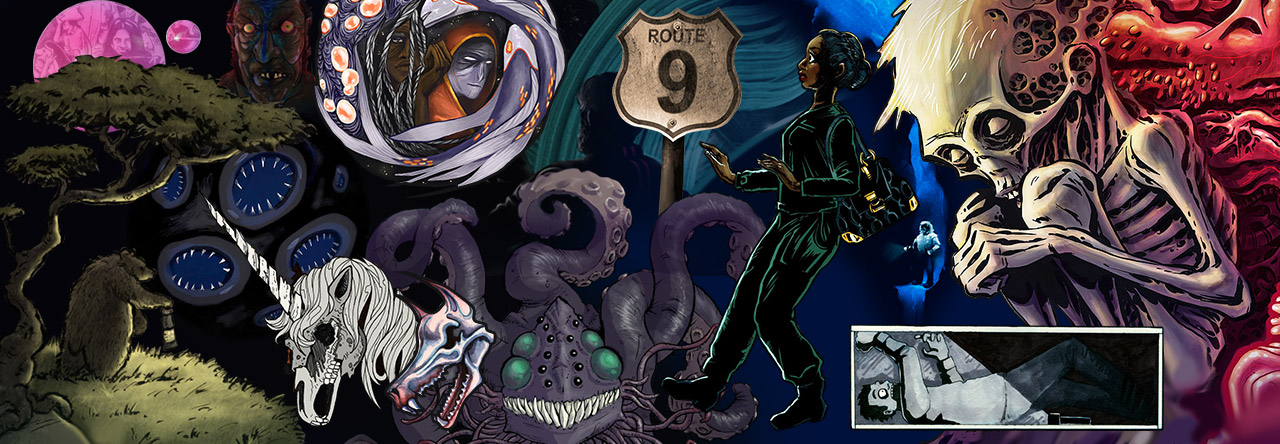

This week on the show, the price for knowledge is steep! The Drabblecast presents an original story, “Storage Spaces,” by Hans Ege Wenger.
Storage Spaces
Hans Ege Wenger
The man next door ate hard drives. That’s what Mrs. Magdalene said, and she knew everybody, and almost everybody’s business at 808 Windsor Place. I imagined it that night when all the lights were off, coming back to the idea in the same way you want to look at a needle going into your arm even after the nurse tells you not to. Old glass platters, like in the computer lab at school, ground down and mixed with Hamburger Helper. New, slender black ones, like in Dad’s digital camera, put between bacon, lettuce, and tomato. A BLTminiSD, disappearing between stained teeth. I was old enough to know that she’d meant it as a figure of speech, and young enough to feel proud to know what that was. But it was fun to imagine.
“He must be eating them,” Mrs. Magdalene had told my mom, as they dragged trash bags down the hall to the chute. “Breakfast, lunch, and dinner.”
“It’s a fire hazard,” my mom sniffed. “Broken computers and dirty wires. Trash he drags in from the dump. I can’t believe it all fits in there. The super should do something about it, Lord knows why she hasn’t already.”
Laney, the superintendent, was a thin lady with a gold bracelet and straight blond hair. I’d tried to call her ‘Ms. Bakewell’ when I met her, but she just laughed and told me that was her mother. Laney lived fifteen minutes away in a neighborhood with bigger yards and less bars on the shop windows. When someone called her from the worn pay phone in the lobby, she would drive down and carefully park her Tesla in the superintendent’s spot. Laney was always talking about costs, and investments, especially when there was a leak in the ceiling or a busted dishwasher. But her eyes slid right by apartment 7A.
Laney tried the first week we moved in. Late rent, she’d said loudly to the whole hallway, banging on apartment 7A. Setting an example, Mom told me under her breath as we carried our groceries into our apartment. I saw the door open, just a crack, and he whispered something to her. Laney went white, whiter than white. She stepped back, shaking her head, and the door clicked quietly closed.
“How did he know?” I heard her ask into her new iPhone as she rushed back to the elevator, looking over her shoulder. That got me interested.
#
When we moved to Windsor place, my dad had asked me how I would act around our new neighbors.
“Respectful,” I answered, and he smiled at me, pale skin brightening for a second. “Polite, and helpful.”
“Good man,” he’d said, placing a too-light hand on my shoulder. “I can’t get around as much as I used to, so I’ll be relying on you to make a good impression.”
I was coming back from school when I saw him in the parking lot. Mr. Denison, I mean, the neighbor who everyone talked about. He was a small man, like a bird, dressed in a pair of faded coveralls and an old ball cap with a dirty brim. Mr. Denison was pushing a little four-wheeled cart into the elevator, full of old computers. It looked heavy.
“Can I help you with that, Mr. Denison?” I asked. Respectful, polite, and helpful. That’s what I’d tell my mom when she asked why I’d talked to him. Curious, too, but that would be my secret.
Mr. Denison smiled at me, in the way that someone who doesn’t smile a lot would, too wide and with too many teeth. Up close, he smelled like a microwave did when you left a spoon inside and turned it on. I’d only made that mistake once, but I hadn’t forgotten it.
“Sure,” he said, after thinking for a few seconds too long to be comfortable. “You’re Ellis, right? Your family moved upstairs a few months ago.”
“Yes sir,” I replied. We pushed the cart together into the old elevator. It creaked and settled, and for a second, I was worried we’d fall.
“Only has to go up five floors,” he said, seeing my nervous eyes. “We’ll make it, even if the elevator isn’t happy about it.” We stood quietly as the floors ticked by. When the doors opened onto our hall, I tried to be polite, respectful, and brave.
“What are you doing with all the computers?” I asked.
“Mostly, I fix them, and I sell them,” Mr. Denison said. “On the internet. I mail things from the post office down the street.”
“That sounds interesting,” I said, feeling like I’d solved a mystery. “Why haven’t you told anyone else? Mrs. Magdalene, I mean, or my mom or Laney.”
He looked sad.
“They never asked,” Mr. Denison said finally, taking the cart back from me. “Thank you for your help, but I’ve got it from here.” As he opened the green-yellow door to apartment 7A, I smelled burning, but I couldn’t find a way to look inside before it was pushed firmly shut.
#
My mom never noticed that I’d been talking to Mr. Denison. She was too busy with work and managing Dad’s appointments. It seemed like there were always more appointments, but I liked it when I started having an hour to myself when I got home from school. Mr. Denison would pull into the parking lot in his rumbling red Ford pickup, and I’d push the cart into the elevator. Or I’d help him carry a bag of carefully addressed brown boxes to the post office. While I helped, he would talk. Once Mr. Denison started talking, it was hard for him to stop, like he’d been saving all the words up for weeks and months and years.
He told me about the parts in a computer and about Windows 95, 98, and XP. Flash drives, SDs, microSDs, cooling fans, and electricity. After a while, I got tired of computers, so he told me about mind palaces and the hidden symbols on the dollar bill. About the crystal mausoleums on the moon and the true meaning of whale songs. One time, he even told me that his daughter would be my age by now, but then he wouldn’t say where she’d gone. Half of it I didn’t understand and the other half I didn’t believe, but I liked to listen. It beat waiting for my parents to come home, especially since we’d sold our flat screen TV to Mrs. Magdalene.
“It’s bad for you,” my mom had said, but I knew that wasn’t the real reason.
One day, I felt brave enough to ask him another question.
“Mr. Denison, why does your apartment always smell like it’s on fire?” I asked. We were pushing the cart over the cracks in the parking lot, which took a lot of concentration.
“The hard drives burn when I use them to ask questions,” he said. All matter of fact, like he wasn’t even thinking about it. I knew about Google, but this was pretty crazy, even for Mr. Denison.
It must have shown, because he froze for a second, thinking. Then, after a moment, Mr. Denison shrugged and kept talking. He told me that your brain could hold the entire internet, but it wasn’t organized. The people he wanted to ask questions to were attracted to patterns in information. Patterns like the ones on a computer hard drive, a hundred hundreds of books laid out perfectly in zeroes and ones. Patterns and blood. If you gave them both, these people would tell you just about anything.
“How does it work?” I said, because even if I didn’t believe him, I still wanted to know.
“Used to be, you’d chant and you’d have a goat, or maybe someone you didn’t like very much,” he said, smiling thinly as if he was telling a joke. “I just connect up the wires on a hard drive to a cut in my arm. Like a circuit, I taught you about those.” He rolled up his sleeve and showed me a fresh bandage on his thin arm, soaked red.
“Then what?” I asked, feeling a little queasy, but still interested.
“Then they visit,” he said. “They visit and they trade. Questions for answers, answers for questions.” I opened my mouth to ask who the visitors were, but he gave me a pinched little look, like he wasn’t sure if he was going to cry or throw up. Then Mr. Denison rushed down the hall and shut the door. I didn’t see him for a few days after that. When I did, he would only talk about computers. Computers and the weather.
#
I tried it the next month. I tried it even though I did a search on Google for ‘blood’ + ‘hard drive’ and there were zero results. I hadn’t studied for my geography test because we had to visit Dad at the hospital. It was five stops away and I couldn’t read on the train without feeling sick, so I didn’t even get to practice the states, let alone the capitals. That night, when Mom started to snore, I snuck out and took the SD card from Dad’s camera. I bit my tongue, hard, tasting blood, and popped it into my mouth.
I was standing on a beach, knee deep in a rocky tidepool. I remembered it from our last vacation. We’d found red-pink sea stars and see-through anemones in the cold water. On the horizon, a wave was growing so high I thought it would touch the sky. Looking down at the gray sand, I saw that I’d dug hundreds of little sand channels from the sea to my little pool.
“Eugh,” I choked on hard plastic and smoke, spitting the card into my hand. It sat there, bloody and hot, daring me to try again.
I pushed the shiny part of the card deep into my gum and bit down. I was back on the beach, watching the ocean come toward me. Water bubbled through the tiny paths and then swept them away in a flood. I felt the cold sea wrap around my ankles and send goose-pimples chasing up the skin under my swim trunks. Knowing that my English textbook said that a metaphor was where one thing was used as a symbol for another. Being sure the beach, the ocean, and the tidepool were metaphors but also understanding that it wasn’t a figure of speech at all.
When the water closed over my head and I started to drown, the visitors spoke to me in voices like the hum of the old tube lights in the laundry room.
“Worship / Sacrifice / Payment,” they said. “Offer / Give / Grant.” They understood, I thought. They understood what I wanted and how much it would cost and that I’d already started paying. I fell away from the white waves and gray sand toward the deep blue shag carpet.
When I woke up, the living room smelled like melted plastic. I scooped up the ruined card with an old newspaper and threw it out the apartment window into the snow. I hoped Dad wouldn’t try to take pictures anytime soon. Then, I lay in bed, staring up at the ceiling, gums bleeding. I knew Juneau, Alaska and Lincoln, Nebraska. I knew the Great Lakes and how many esses there were in Mississippi. There was other information that had washed in too, like fish left on the beach after high tide. I knew the locations of all fourteen Ohio class nuclear-armed submarines and the Akkadian words ‘sha naqba imuru.’ But I didn’t know the name of my neighbor down the hall. It had slipped away, into the waves.
#
The doctors said it wasn’t treatable. Incurable. That was the word my Mom used to explain it to me, because Dad was too tired to explain anything. She told me we would have to look at other options. She said Dad would come home before he went to a place called a hospice, but when I asked her what that was, she started crying. I hugged my mom and left for school, because I didn’t know what else to do. After walking a few blocks, I realized that I didn’t know where my bus stopped anymore. Instead, I remembered the definitions of the words ‘aqueous,’ and ‘alienage,’ and ‘arthropod.’ I also remembered that my dad’s camera had a second SD card.
It was easier this time. No beach, no tidepools, just the salty, drowning black. But it wasn’t enough, the visitors told me in their crackle-hum voices. Limited. So few patterns to anchor to as they considered the growth of human disease called glioblastoma. So little blood, drip drip dripping from my lips onto the stained tile of the utility closet. But they were happy I’d asked. They still had a few ideas, actually They told me there were forty-three hard drives in apartment 7A. They told me what to say to get my neighbor to open the door and what angle to hold the knife. I knocked on the green-yellow wood and waited, feeling their anticipation humming in the spaces between my thoughts.
#
The police broke down my neighbor’s door when the smell got bad. Watching from the end of the hall, I thought about him. About the post office, about pushing a cart down the sidewalk together. Learning what a circuit was and how operating systems worked. Seeing him laugh, all creaky, as if his voice was rusty from not being used. I thought that he would have called me a name, and I would have called him one in return. But there was a hole in my head where both those things used to be. If I tried, I could feel their edges, like the space left by a loose tooth.
This morning, Mom got a call from the hospital. I heard the doctor tell her about an experimental treatment. That it was sent to sixty biomedical journals anonymously. That my dad could be one of the first to sign up, if he was interested. And I remembered. I remembered telling my neighbor that no one ever had to die like his daughter did again. I remembered us tying forty-seven hard drives together with sparking wires. I remembered the bright knife in his hand, and I remembered saying goodbye. Most of all, I remembered the visitors’ satisfaction as they nested deeper in the empty spaces of my brain. Waiting for the next question.

Podcast: Download
Leave a Reply
You must be logged in to post a comment.